How to Start Forex Trading for Beginners with a Step-by-Step Plan
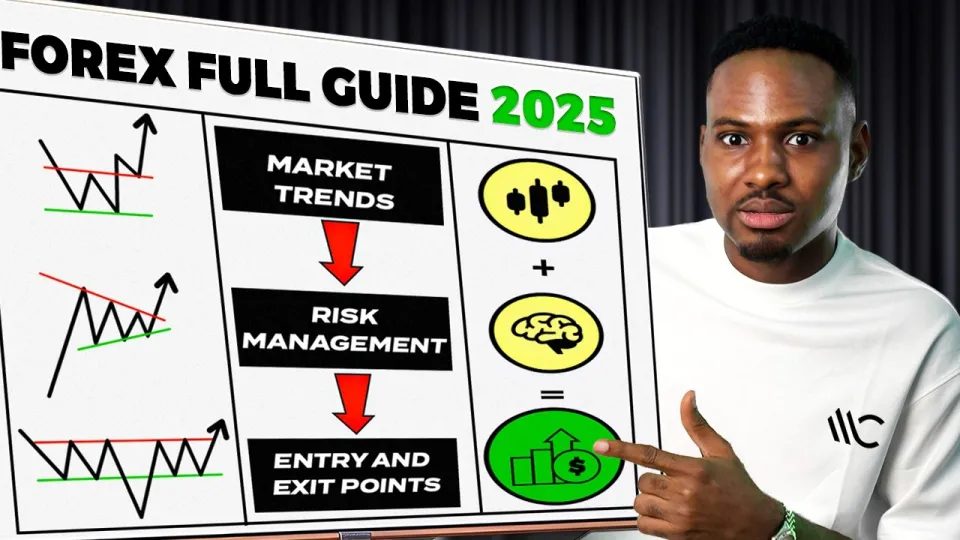
Video: How To Start Forex Trading For Beginners’ 2025 (Full Course)
Need articles like this for your video? They help promote it on YouTube and Google — order them in the Telegram bot @sat_sit_bot. The bot writes and publishes the articles itself (with your YouTube video embedded) on popular topical websites (no ads). Free trial — 50 articles.
· based on the channel Jeffrey Benson Forex
Key takeaways
- Forex is trading currency pairs, where the price is the exchange rate of one currency against another, such as EUR/USD.
- The market runs 24 hours a day, five days a week, split into four main sessions: Sydney, Tokyo, London and New York.
- A beginner needs a broker account, a trading platform such as MetaTrader 5, a demo account and a written trading plan.
- Risk management comes before strategy: fix a maximum risk per trade, usually 1–2% of the account, and set a stop-loss before entry.
- Jeffrey Benson Forex structures its beginner course around market basics, tools, strategy, a first trade and mistakes to avoid.
Forex trading for beginners starts with three practical steps: open a broker account and a demo, learn how currency pairs and market sessions work, and only then trade a simple strategy with a fixed risk limit on every position. The full beginner path — from what forex is to placing a first order — is laid out in the free course by Jeffrey Benson Forex, and the paid student program behind it is available at the Fire Pips FX plans page.
What forex trading is and how currency pairs are quoted
Forex is the market where national currencies are exchanged in pairs, and the quoted price is simply how much of the second currency one unit of the first costs. EUR/USD at 1.0850 means one euro buys 1.0850 US dollars; when the number rises, the euro strengthens against the dollar, and when it falls, the dollar strengthens. Nothing is delivered physically in retail trading — a beginner is speculating on the direction of the rate.
Three terms cover almost everything a new trader needs at the start:
- Base and quote currency. In USD/JPY the dollar is the base and the yen is the quote; the price shows how many yen one dollar costs.
- Pip. The standard smallest move, usually the fourth decimal place for most pairs and the second decimal for yen pairs.
- Lot. The position size. A standard lot is 100,000 units of the base currency, a mini lot is 10,000 and a micro lot is 1,000, which is why micro lots are the normal starting point on a small account.
Major pairs such as EUR/USD, GBP/USD, USD/JPY and AUD/USD carry the tightest spreads and the deepest liquidity, so they are the sensible first market for a beginner. Exotic pairs look tempting because they move more, but wider spreads and gaps make them a poor training ground.
How the forex market works across four sessions
The forex market has no central exchange; it is an over-the-counter network of banks, funds, brokers and retail traders, running 24 hours a day from Monday to Friday. Liquidity and volatility move with the clock, because activity follows the business day from east to west.
- Sydney session opens the trading week and is the quietest of the four.
- Tokyo session brings the Asian range, with the yen pairs most active.
- London session is the heaviest by volume and typically sets the day's high or low.
- New York session overlaps London for a few hours, and that overlap is the most liquid window of the day.
For a beginner, the practical consequence is simple: the same strategy behaves differently at 3 a.m. and during the London–New York overlap. Pick one session, study how price behaves in it, and ignore the rest until the process is consistent.
Tools and accounts a beginner needs before the first trade
A beginner needs four things before risking money: a regulated broker, a trading platform, a demo account and a written plan. Everything else — indicators, signal groups, paid courses — is optional and comes later.
- Broker. Check regulation, spreads on major pairs, minimum deposit and how orders are executed. The course author recommends Assex Markets and links registration at https://my.assexmarkets.com/auth/register?partner_code=1699134; whatever broker you choose, verify its licence yourself before funding.
- Platform. MetaTrader 5 (MT5) is the standard: charts, order types, stop-loss and take-profit, and a strategy tester. MT4 remains common, and most brokers support both.
- Demo account. Trade the same lot sizes and the same rules you intend to use live, for at least a few weeks. A demo where you risk 10% per trade teaches nothing.
- Trading journal. Record entry, exit, reason for the trade and result. Reviewing twenty logged trades reveals more than twenty more videos.
A practical order of operations is: register, download the platform, connect the account, run the demo, then fund a small live account only after the demo results are stable.
A basic strategy foundation built on structure and risk
A workable beginner strategy is built on market structure, one or two confirmation tools and a fixed risk rule, not on a stack of indicators. Price moves in trends, ranges and reversals; the job is to identify which one is in play on the higher timeframe before looking for an entry on the lower one.
A simple framework:
- Mark the trend on the daily or four-hour chart — higher highs and higher lows, or the opposite.
- Wait for price to pull back to a level where the trend previously resumed, such as a prior swing high or low.
- Confirm with one tool only — a moving average, a support-and-resistance zone or a candlestick pattern.
- Set the stop-loss beyond the level that would invalidate the idea, then size the position so the loss is 1–2% of the account.
- Define the target in advance, at a minimum of twice the risk, so a 50% win rate still leaves the account profitable.
That last point is the whole edge in one line: with a 1:2 risk-to-reward ratio, being right half the time is enough. Most beginners fail not because their entries are bad but because they risk too much per trade and abandon the plan after two losses.
Placing a first trade without gambling
Placing a first trade means choosing a pair, a direction, a lot size, a stop-loss and a take-profit — in that order, before clicking buy or sell. On MT5 the sequence is: open the symbol, set the order type, enter the volume, fill in the stop-loss and take-profit fields, and confirm.
Worked example on a $500 account with a 1% risk rule: the maximum loss is $5. On EUR/USD with a 20-pip stop, a micro lot (0.01) is worth roughly $0.10 per pip, so a 20-pip stop risks about $2 — well inside the limit. A mini lot would risk about $20, four times too much. Position size is calculated from the stop distance, never guessed.
Two habits make the difference between a trade and a bet: never move the stop-loss further away to avoid being closed out, and never add to a losing position. If the setup is invalidated, the trade is over.
Common beginner mistakes and the questions they raise
The most expensive beginner mistakes are structural, not technical: risking too much, trading without a stop, switching strategies after every loss and following signals without understanding them. Risk management is the part most new traders skip, and it is the part that decides whether an account survives its first bad week.
- Overleveraging. A single oversized lot can erase weeks of gains in minutes; micro lots exist precisely to prevent this.
- No stop-loss. A position without a stop is an open-ended liability, especially over a weekend gap.
- Strategy hopping. Ten strategies tried for a week each produce zero data; one strategy tested for a hundred trades produces a real sample.
- Signal dependence. Copying trades without knowing the entry logic means you cannot manage the position when the signal author is asleep.
- Skipping the journal. Without records, the same mistake repeats unnoticed.
A recurring doubt among viewers is whether a course alone is enough to become profitable. The honest answer: education shortens the learning curve, but screen time, a demo account and a written record of results are what turn knowledge into skill.
Useful links from the course
- Fire Pips FX student plans — the author's paid mentorship and course program.
- https://t.me/firepipsignals — one free trade idea posted daily.
- https://my.assexmarkets.com/auth/register?partner_code=1699134 — broker registration recommended in the video.
- https://t.me/jeffreybenzhelpbot — entry point to the premium signal group.
- https://youtu.be/oJ9Cz6dPZw0 — the author's guide to linking a broker account to MT5.
Final thoughts on starting forex the right way
Forex rewards process, not enthusiasm: a regulated broker, a demo account, one simple strategy, a fixed 1–2% risk per trade and a journal will take a beginner further than any indicator pack. The full beginner course by Jeffrey Benson Forex is a solid structured starting point, and the same channel is worth following for its chart breakdowns and risk-management explanations. Treat the first months as tuition paid in screen time rather than in losses, and only scale up once the records show consistency. If you want the author's structured mentorship, start at the Fire Pips FX plans page.
Source: How To Start Forex Trading For Beginners’ 2025 (Full Course) · Markdown version
Questions & answers
How much money do I need to start forex trading?
You can open a live account with a few hundred dollars, and some brokers accept less, but the amount matters less than the risk per trade. With a $500 account and a 1% rule, the maximum loss per trade is $5, which is why micro lots are the practical starting size. Many traders spend the first weeks or months on a demo account before funding anything.
Can I learn forex trading for free?
Yes. Broker demo accounts, platform documentation and free video courses cover the basics of currency pairs, sessions, order types and risk management without payment. What free material cannot replace is screen time and a trading journal; paid mentorship mainly compresses the learning curve and adds feedback.
Is forex trading gambling?
Forex becomes gambling when position size is chosen by feeling, stops are absent and outcomes depend on luck. It behaves more like a probabilistic business when every trade has a predefined stop-loss, a fixed risk of 1–2% of the account and a risk-to-reward ratio of at least 1:2. The market is uncertain either way; the difference is whether the losses are controlled.
How long does it take to become profitable in forex?
There is no fixed timeline, and anyone promising one is selling something. A realistic path runs through several months of demo trading, a documented sample of at least a hundred trades on one strategy, and gradual scaling only after the results are consistent. Most beginners who fail do so because of risk, not because of a lack of indicators.